
Pay transparency 2026: a practical HR guide
The EU Pay Transparency Directive (2023/970) is now in force. Italian companies, and organizations across Europe, must fundamentally rethink their compensation policies.

The EU Pay Transparency Directive (2023/970) introduces a new standard for salary transparency across Europe. Organizations are now expected to implement significant changes to their compensation policies, including:
- salary ranges in job advertisements
- a ban on asking candidates about their salary history
- regular gender pay gap reporting
This is far more than another compliance requirement. It represents a fundamental shift in how organizations approach compensation. This guide explains what is changing, what HR teams should do now, and how to prepare before the new obligations become fully enforceable.
1. What is the EU Pay Transparency Directive (2023/970) and why does it matter
Adopted by the European Parliament on 10 May 2023 and published in the Official Journal of the European Union on 17 May 2023, the Directive establishes binding measures to strengthen the principle of equal pay for equal work through greater pay transparency and stronger enforcement mechanisms.
EU Member States have until 7 June 2026 to transpose the Directive into national law. This means organizations should start preparing today: not when local legislation is finalized.
The problem the directive aims to solve
Across the European Union, the gender pay gap remains around 13%, meaning women earn approximately 13% less per hour than men on average.
According to Eurostat, Italy reports a slightly lower gap of around 10.7%, although the difference becomes significantly larger when annual earnings are considered, reflecting women’s lower representation in senior positions and higher rates of part-time employment.
This gap is not solely the result of explicit discrimination, which has long been illegal. Much of it stems from opaque compensation systems, where salaries are negotiated individually without objective evaluation criteria or documented decision-making processes. The Directive aims to break this cycle by making pay transparency a structural mechanism for preventing inequality rather than correcting it after the fact.
Why companies should start now
Many organizations are waiting for their national implementing legislation before taking action. That is a mistake for two reasons.
- Implementation takes time. Developing an objective job evaluation framework, creating salary bands and implementing reliable monitoring systems requires months, not weeks. Organizations that begin today will be fully prepared. Those who wait risk rushing implementation under regulatory pressure
- Competitive advantage. Companies embracing pay transparency ahead of legal deadlines position themselves as employers of choice. Transparent compensation policies strengthen employer branding, attract stronger candidates and resonate particularly well with younger generations, who increasingly view pay fairness as a deciding factor when choosing an employer
2. From reactive to predictive compensation management
Traditionally, organizations manage compensation reactively. Salary reviews typically occur only after:
- employee complaints
- salary negotiations
- union disputes
- legal claims
The Directive requires companies to move toward a predictive and preventive approach. Organizations must be capable of identifying pay anomalies before they become legal or organizational problems and justify every compensation decision using objective, documented criteria.
Traditional approach
Directive driven approach
Individual salary negotiations
Structured salary bands
Implicit criteria
Objective, measurable criteria
Confidential salary information
Transparent communication
Pay gap analysis only after disputes
Continuous monitoring
Corrective action after problems arise
Systematic prevention
This does not mean publishing every employee’s salary. It means building a compensation system where every pay decision can be explained, documented and defended before employees, unions, regulators or courts.
3. What changes for HR
The Directive affects every stage of the employee lifecycle.
Salary Ranges in Job Advertisements
Employers will be required to disclose either the salary or salary range before the first interviewimpossibile da rispettare in modo coerente. The objective is to eliminate information asymmetry, which historically disadvantages candidates (particularly women) during salary negotiations.
🔎 Practical implication: every open position must be linked to a clearly defined salary band. Without structured job evaluation and salary banding, compliance becomes nearly impossible.
Salary history can no longer be requested
Employers will no longer be allowed to ask candidates about previous salaries. This practice tends to perpetuate historical inequalities. If an employee has previously been underpaid, basing future compensation on past earnings simply reproduces existing pay gaps instead of correcting them.
🔎 Practical implication: Recruitment processes, application forms and interviewer training all need updating.
Employees gain new information rights
Employees will have the right to request information about average pay levels, broken down by gender, for employees performing the same work or work of equal value. Organizations must respond within two months.
🔎 Practical implication: companies need reliable HR data capable of producing accurate reports quickly. Without proper monitoring systems, every request becomes a manual emergency.
Mandatory Gender Pay Gap reporting
Organizations employing more than 100 employees must publish regular reports on their gender pay gap. Reporting frequency depends on company size:
- 250+ employees: annually
- 150–249 employees: every three years
- 100–149 employees: every three years (subject to national implementation)
🔎 Practical implication: these reports cannot be created manually each time. They require continuous HR data collection supported by robust digital infrastructure.
Joint pay assessment
If reporting identifies an unjustified gender pay gap exceeding 5%, and the issue is not corrected within six months, employers must conduct a joint pay assessment together with employee representatives.
4. Building a compliant compensation system
#1 Objective Job Evaluation
The starting point is a structured job evaluation process. Every role should be assessed using gender-neutral criteria, including:
- required technical and behavioural competencies
- level of responsibility
- complexity and cognitive effort
- working conditions
Each position receives an objective score that forms the basis for compensation decisions. Without this foundation, salary transparency cannot be achieved.
#2 Creating Salary Bands
Once roles have been evaluated, organizations can create salary bands by grouping positions with similar value. This includes:
- market salary benchmarking
- defining minimum, midpoint and maximum salary ranges
- mapping existing employees into the appropriate bands
- identifying compensation anomalies
- documenting justified exceptions
The process immediately highlights employees below or above salary ranges and inconsistencies between comparable roles.
#3 Continuous Monitoring Through HR Dashboards
Compliance is not a one-time project. Compensation evolves constantly. An effective monitoring system should enable HR teams to:
- detect salary deviations in real time
- monitor the gender pay gap by department, role and seniority
- automatically generate compliance reports
- flag high-risk compensation decisions
- respond quickly to employee information requests
Without dedicated dashboards, monitoring becomes an unreliable spreadsheet exercise.
5. How LIVREA simplifies compliance
Smartpeg has developed a dedicated Pay Transparency module within LIVREA, designed to guide HR professionals through every stage of compliance using Artificial Intelligence.
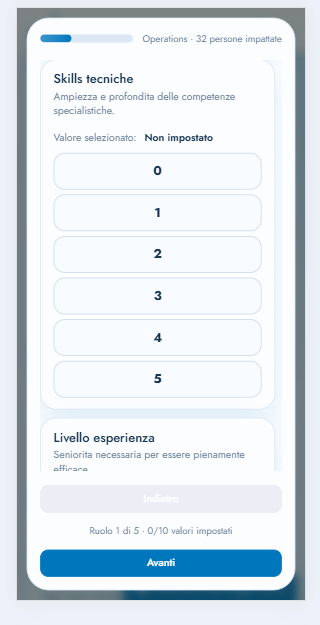
#1 AI-Assisted Job Evaluation
The module evaluates roles according to Directive-compliant criteria, including:
- skills and competencies
- responsibility level
- effort
- complexity
- working conditions
Its distinctive feature is AI-assisted job weighting, providing HR teams with an objective starting point that can then be reviewed and customized.
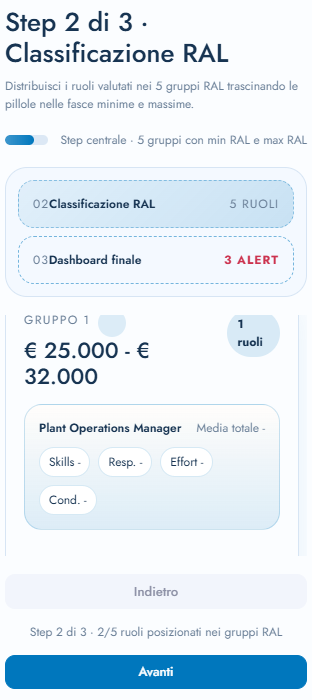
#2 Salary Band Assignment
Once job evaluations are completed, every role can be associated with its corresponding salary band. Employees are automatically mapped into the appropriate range, making inconsistencies immediately visible.
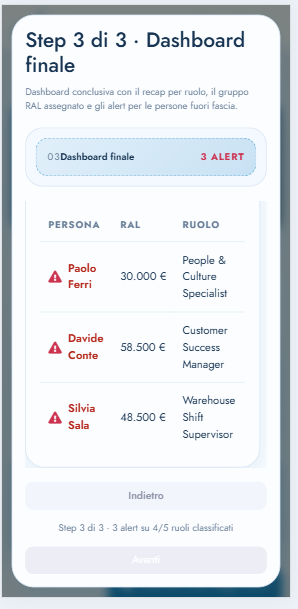
#3 Pay Transparency Dashboard
The dashboard provides an instant overview of organizational compensation, allowing HR to:
- detect pay anomalies
- monitor the gender pay gap
- support strategic HR decisions with real-time data
- generate compliance reports automatically
The guiding principle is simple: from data to decisions. Not merely regulatory compliance, but smarter compensation governance.
6. Risks of non-compliance
The Directive is legally binding. National legislation must introduce effective, proportionate and dissuasive penalties.
Potential consequences include:
- financial penalties
- reversal of the burden of proof in discrimination cases
- full compensation for affected employees
- public disclosure of sanctions
Beyond legal consequences, organizations also face:
- increased litigation risk
- employer branding damage
- difficulty attracting and retaining top talent
- more complex negotiations with employee representatives
7. Final thoughts
The EU Pay Transparency Directive should not be viewed as another administrative burden. It is an opportunity to build compensation systems that are fairer, more transparent and more sustainable.
Organizations that move first will gain significant competitive advantages:
- stronger employer branding
- lower legal risk
- more efficient HR processes
- greater employee trust
- improved talent attraction and retention
The roadmap is clear:
- Evaluate jobs using objective, gender-neutral criteria
- Build transparent salary bands and map existing employees accordingly
- Implement continuous monitoring capable of identifying anomalies before they become problems
The roadmap is clear:
- Evaluate jobs using objective, gender-neutral criteria
- Build transparent salary bands and map existing employees accordingly
- Implement continuous monitoring capable of identifying anomalies before they become problems
In the era of data-driven HR, pay transparency is no longer optional: it is becoming a strategic capability.